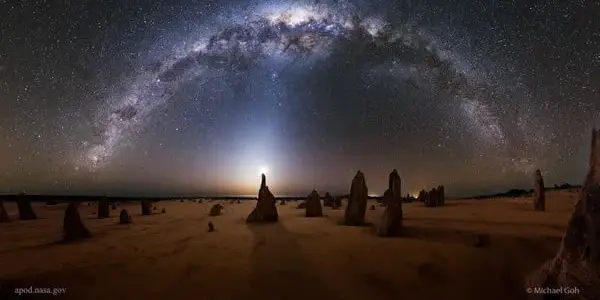
On late Spring and Summer evenings, the days are long and the nights
relatively short, so one has to stay up quite late for it to be dark
enough to see the stars.
If the skies are clear - we can see some familiar star patterns, including
the Great Bear and Little Bear, Leo, (the Lion), Virgo, (the Maiden),
Scorpius, (the Scorpion), and many others.
In the late evening, from dark locations, the faintly glowing band of the
Milky Way will be seen arching right across the eastern and north-eastern
sky. This band of faint stars is the disk of the great stars system to
which we belong – our Galaxy – whose stars are all around us. This is best
seen when there is no bright Moon in the sky. The Moon will be full this
year on May 23rd, June 22nd and July 21st.
If you want to spot some planets you will need to stay up late or get up
early in the morning before dawn. In early June, the beautiful ringed
planet Saturn rises at about 2am and the Red Planet Mars an hour later
just as twilight is brightening the eastern sky. By early July, both of
these planets will be rising
here is also a fine display of planets. The lovely Red Planet Mars is seen
as soon as darkness falls, and the beautiful ringed planet Saturn is also
well placed. Venus becomes a brilliant object in the early morning sky by
the end of June. A month later, in early July, Saturn will be rising
before midnight, Mars before 2am and the brilliant giant planet Jupiter
only half an hour later – all three visible in a dark sky before dawn
twilight interferes.
Come to the Planetarium for a breathtaking tour of the night sky and to
find out more about what there is to be seen on clear evenings in late
spring and early summer.
Please book as far in advance as you can to avoid disappointment.
If you do not see your Order Confirmation Email shortly remember to
check your SPAM folder
Opening Times
Only open 45 minutes before advertised show times.
Prices and Admission
Admission: Adults £8:00. Children 6 to 16 years £6:00.
Not Suitable for children under 6 years of age.
Duration 70 min Approx
Gift Aid
Please also consider making a donation under the Gift Aid scheme. It
costs you nothing and gives us more.
Download the Gift Aid form
here
Accessibility
All public areas of the Planetarium are accessible to wheelchairs.
Disabled parking bays are available
Toilets
The Planetarium has two easy access, gender neutral toilets, one of
which is slightly larger so as to accommodate carers if this is
necessary.
Seating
The seats in the main auditorium are ex-aircraft seats. Those in the
first two rows are set at a slightly reclined angle to provide the best
possible view. They can, however, be tipped forwards to enable easier
access to the rows behind when entering and leaving. The seats in the
back row do not recline. They provide a wide view of
the entire dome area, which some of our visitors prefer. The auditorium
is fully accessible to wheelchairs.
Directions & Map
Important DO NOT rely on Google Maps
There is no direct access off the Chichester Bypass. All access via
Kingsham Road only.
SEE MAP BELOW.
Satnav postcode use PO19 8EB
The only entrance for walkers, cars buses, lorries,
coaches, PoGo sticks or Space Hoppers, is by the High School entrance in
Kingsham Road, then follow the signs to "The South Downs Planetarium and
Science center" It is located at the southern end of the Chichester High
Schools campus.